Submit a news tip or story directly by texting us at: 301-500-0440
Clean Streets
Kendesimohammed.com - Washington DC, Maryland, Virginia local new
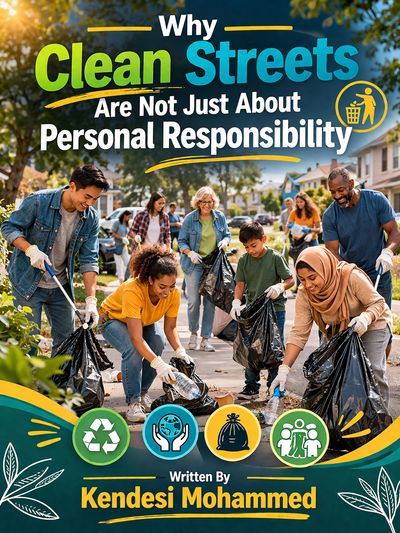
Why Clean Streets Are Not Just About Personal Responsibility
Written By Kendesi Mohammed
The question is often asked in quiet conversations, public debates, and online forums. Why don’t people in underserved communities pick up trash in their neighborhoods? At first glance, it may seem like a simple issue of personal responsibility. But that assumption misses a deeper truth. Clean streets are not just the result of individual choices. They are shaped by systems, resources, and the conditions people live under every day.
In many underserved communities, the problem begins with infrastructure. Trash collection may be inconsistent. Public trash bins are often limited or poorly maintained. Illegal dumping can go unchecked for long periods. When sanitation systems fail or are unreliable, the burden shifts unfairly onto residents. Over time, people begin to feel that their individual efforts will not make a lasting difference. Picking up trash today does not stop more from appearing tomorrow.
There is also the question of time and capacity. Many residents in these communities are working multiple jobs, raising families, and navigating financial stress. Their daily lives require constant focus on survival and stability. In that reality, picking up trash outside their homes, while important, is not always urgent. It becomes a lower priority compared to putting food on the table, paying rent, or ensuring their children are safe.
Housing instability plays a role as well. When people do not feel a long-term connection to where they live, it becomes harder to invest emotionally and physically in maintaining the space. Pride in a neighborhood often grows from a sense of ownership and permanence. Without that, even well-intentioned efforts can feel temporary.
There is also a broader social dynamic at work. One person cleaning a block cannot sustain cleanliness if others continue to litter or dump waste. This creates a collective action problem. When individuals do not see others participating, they are less likely to continue their own efforts. Over time, this leads to frustration and disengagement.
Urban researchers have long examined how visible disorder influences behavior. The Broken Windows Theory suggests that environments marked by neglect can reinforce further neglect. When a neighborhood appears uncared for, it sends a message that maintenance is not expected or valued. That perception can shape how people treat the space, regardless of their personal values.
Equally important is the issue of investment and respect. Communities that feel overlooked by local government and institutions often reflect that neglect in their surroundings. When residents see consistent services, clean streets, proper lighting, and active community programs, they are more likely to take pride in where they live. Investment signals that a neighborhood matters, and that message can be powerful.
It is also critical to recognize that many people in underserved communities are already doing the work. They organize cleanups, look after their blocks, and try to create better environments for their families. These efforts often go unnoticed, but they are real and meaningful.
The conversation should not focus on blame. It should focus on solutions. Clean neighborhoods are built through partnership. Local governments must provide reliable sanitation services and enforce regulations against dumping. Community leaders and organizations must continue to engage residents and create opportunities for collective action. Businesses and institutions must invest in the neighborhoods they serve.
Most importantly, we must shift how we think about the issue. Clean streets are not simply a reflection of individual behavior. They are a reflection of how society chooses to invest in and value its communities.
If we want cleaner neighborhoods, we must build systems that make it possible, sustainable, and worthwhile for people to care.
#CommunityNews #Localnews #kendesi #kendesimohammed #kendesitv
More Than 70 Million Lives Lost
Kendesimohammed.com - Washington DC, Maryland, Virginia local new
More Than 70 Million Lives Lost: Power, Conflict, and Identity in a Changing World
Written By Kendesi Mohammed
For centuries, Europe was shaped less by unity and more by persistent conflict. From the Thirty Years’ War, which led to an estimated 4 to 8 million deaths, to the widespread destruction of the Napoleonic Wars, and later the global devastation of World War I and World War II, the European continent has endured repeated cycles of violence. The two world wars alone resulted in more than 70 million deaths worldwide, with Europe at the center of that destruction.
Beyond these major events, European powers engaged in hundreds of conflicts driven by territorial ambition, religious division, and political rivalry. For long stretches of history, war was more common than peace. These repeated crises eventually pushed nations toward cooperation, leading to the creation of institutions such as the European Union, which sought to reduce the likelihood of further internal wars.
At the same time, European expansion across the globe introduced systems that reshaped entire populations. The Transatlantic Slave Trade forcibly displaced more than 12 million Africans and established racial hierarchies that continue to influence modern societies. In the Americas, Indigenous communities faced displacement, violence, and cultural erasure on a massive scale. These developments were tied to economic ambition and competition among powerful nations.
The global role of the United States reflects some of these historical patterns while also presenting its own contradictions. The country was founded on principles that rejected empire and emphasized self governance. Over time, however, it expanded its influence across the world, building alliances, maintaining military presence abroad, and shaping international affairs in profound ways.
This evolution has led to comparisons with the Roman Empire. Rome began as a republic grounded in civic participation, yet it gradually extended its reach through conquest and political control. As its territory grew, its identity shifted, and maintaining authority across distant regions became increasingly complex.
The comparison invites reflection. A nation that extends its influence beyond its borders must also remain grounded in its internal values and sense of purpose. When attention is directed outward for too long, internal challenges can intensify, including economic inequality, political division, and uncertainty about national direction.
History does not repeat itself in exact form, but it often echoes. The experiences of Europe and Rome demonstrate how power, expansion, and identity are closely connected. They also show that strength is not measured only by influence abroad, but by stability and clarity at home.
Honest conversations about war, colonization, and global power are necessary, even when they are uncomfortable. A deeper understanding of these forces allows societies to move forward with greater awareness and intention. The future will be shaped not only by the reach of power, but by the discipline to define what that power is meant to serve.
#GlobalPolitics #WorldHistory #AmericanIdentity #PowerAndInfluence #Geopolitics

Legacy Lives On
Kendesimohammed.com - Washington DC, Maryland, Virginia local new
The Legacy Lives On: A Call to Purpose, Faith, and Unity
Written By Kendesi Mohammed
They thought they killed Malcolm X, Martin Luther King Jr., John F. Kennedy, Abraham Lincoln, and even the children who stand for freedom.
But they did not.
Their ideas, their legacy, and their vision are still alive.
You can speak against God’s children. You can try to remove them from their purpose. But those chosen by God do not die in spirit. You may remove their bodies from this earth, but they continue to live in the hearts of the people.
You may refuse to give reparations for slavery, one of the most horrific crimes against humanity. You may attempt to suppress Black people. But God has already spoken: the first shall be last, and the last shall be first.
Now, to my brothers and sisters who believe the scriptures are fake, or that they were created by our enemies, I say this: the scriptures are real, and we must live by them.
We must love our brothers and sisters as we love God. We must treat one another with love, respect, and kindness.
Do not allow distractions to pull you away from your purpose.
We are here on a mission.
We have a vision.
We have an objective.
And we have a purpose.
Our purpose will always be to serve God.
#LegacyLivesOn #FaithAndPurpose #BlackExcellence #UnityInCommunity #ServeGod #TruthAndJustice #ReparationsNow #StayFocused #SpiritualStrength #MissionDriven #VisionAndPurpose #LoveAndRespect #GodsChildren #RiseUp #CommunityPower
Transatlantic Slave Trade
Kendesimohammed.com - Washington DC, Maryland, Virginia local new
The True Cost of the Transatlantic Slave Trade Lives On
Written By Kendesi Mohammed
The transatlantic slave trade stands as one of the most devastating systems in human history. Its scale is difficult to fully comprehend, not only because of the millions who perished, but because of the lasting consequences that continue to shape societies across the world.
Historians estimate that between 12 and 12.5 million Africans were forcibly taken from their homes and transported across the Atlantic. Of those, roughly 10.5 million survived the journey. The voyage itself, known as the Middle Passage, claimed the lives of an estimated 1.5 to 2 million people. Yet the suffering did not begin or end there. Millions more died during violent raids, forced marches to the coast, and the brutal conditions that followed their arrival in the Americas.
When the full scope is considered, including those who died during capture, transport, and early enslavement, many scholars place the total human toll between 10 and 15 million lives. Some argue the number may be even higher when accounting for indirect deaths caused by war, displacement, and societal collapse across parts of Africa.
But the tragedy of the slave trade is not confined to the past. Its consequences are still very much alive.
Today, hundreds of millions of people around the world are descendants of those who were enslaved. In the United States alone, more than 40 million African Americans trace their ancestry to this history. Across the Caribbean and Latin America, tens of millions more carry the legacy. Brazil, for example, is home to the largest population of people of African descent outside of Africa.
The impact is not only demographic. The slave trade helped construct economic and social systems that continue to produce inequality. Wealth gaps, disparities in education and opportunity, and persistent racial discrimination all have roots in this history. Entire regions, particularly in parts of Africa and the Caribbean, were left economically weakened after centuries of exploitation and extraction.
There is also widespread misunderstanding about the financial relationships between Caribbean nations and former colonial powers. Most Caribbean countries do not pay direct taxes to Britain or other European nations today. However, that does not mean the economic burden of history has disappeared. In some cases, newly independent nations were forced into crippling financial arrangements that shaped their futures for generations. Haiti, for example, was required to pay a massive indemnity to France as the price of its independence, a debt that stunted its economic development for over a century.
Across the Caribbean, leaders continue to call for reparations, arguing that the wealth of European nations was built in part on the exploitation of enslaved people, while the descendants of those people continue to face systemic disadvantages.
Understanding the true cost of the transatlantic slave trade requires more than counting the dead. It requires acknowledging the enduring structures it created and the lives still shaped by its legacy. The numbers are staggering, but the human impact extends far beyond statistics.
This is not just history. It is a living reality that continues to influence the present and shape the future.
#TransatlanticSlaveTrade #HistoryMatters #BlackHistory #AfricanDiaspora #Reparations #SocialJustice #HumanRights #ColonialHistory #CaribbeanHistory
#CommunityNews #Localnews #kendesi #kendesimohammed #kendesitv

Fear can slow progress. Hate can divide communities

Never Let Fear or Hate Define Your Worth
Written By Kendesi Mohammed
Throughout history many people have tried to project their fears, insecurities, and hatred onto others. They attack ideas they do not understand. They reject people who challenge their comfort. They attempt to silence voices that remind them of their own weaknesses. But one of the most important lessons in life is this: you must never allow someone else's fear or hate to define who you are.
Fear often comes from ignorance. Hate often grows from insecurity. When people feel threatened by progress, creativity, intelligence, or courage, they sometimes respond by attacking the very people who represent those qualities. Instead of growing themselves, they try to pull others down.
History provides many powerful examples of this pattern.
When Martin Luther King Jr. stood up for civil rights and equality, he faced hatred, threats, and violence. Many people feared the idea of equality because it challenged a system that gave them power. Yet King refused to allow that hate to silence him. His courage helped lead to the Civil Rights Movement, which changed the course of American history.
Another example is Nelson Mandela. For fighting against racial injustice in South Africa, he was imprisoned for 27 years. The system of Apartheid was built on fear and division. Many leaders feared losing control and power, so they tried to destroy the voices calling for freedom. Mandela refused to let hatred define him. When he was finally released, he led his country toward reconciliation rather than revenge.
Even scientists and thinkers have faced the same resistance. Galileo Galilei was punished for supporting the idea that the Earth revolved around the Sun. At the time, powerful institutions feared the truth because it challenged their authority. Yet today his discoveries helped shape the foundation of modern science.
These stories remind us that progress often begins with individuals who refuse to accept fear and hatred from others.
People who hate or attack you are often revealing more about themselves than they are about you. They may fear your potential. They may resent your discipline, your creativity, or your vision. Instead of confronting their own limitations, they try to discredit the person moving forward.
But history shows that those who stay focused on their purpose eventually outlast the voices of fear.
The world advances because of people who keep building, creating, and believing even when others doubt them. Artists create new sounds. Writers share new ideas. entrepreneurs build new businesses. Leaders inspire communities. These individuals are often criticized first and celebrated later.
The lesson is simple but powerful. Never allow someone else's fear or hatred to become the measure of your worth. Do not shrink your vision because others are uncomfortable with it. Do not silence your voice because someone else is afraid of change.
Instead, let history remind you that the greatest contributions to humanity have often come from people who refused to be controlled by the fears of others.
Fear can slow progress. Hate can divide communities. But courage, persistence, and purpose can transform the world.
And the people who refuse to bow to fear are often the ones who move history forward.
#kendesi #kendesinews #kendesimedia
Game of Chess

Politics Is Often a Game of Chess
Written By Kendesi Mohammed
Before we know it, political rivals sometimes become allies or even friends. Many Americans remember when it seemed that Barack Obama and George W. Bush represented completely different worlds in American politics. Their policies, philosophies, and political parties placed them on opposite sides of many national debates. Yet in the years after their presidencies, the public has witnessed moments of mutual respect, shared laughter, and cooperation.
This reality reminds us that politics is often more complex than it appears on television screens or campaign stages. What looks like hostility or deep division during elections can later transform into civility and understanding. Leaders who once debated fiercely sometimes recognize the unique burden of serving as president and develop a level of respect that only a few people in the world can truly understand.
There have even been discussions over the years about distant ancestral connections among prominent American families. Genealogists have found that many individuals in the United States share distant family ties that stretch back generations. While such discoveries may surprise the public, they are not unusual in a country with centuries of interconnected history.
From the outside, politics can resemble a game of chess. Moves are calculated. Strategies unfold slowly. Alliances shift over time. The public often sees only a portion of the board while the full strategy develops behind the scenes.
Recently, the public has also seen moments of political tension between Donald Trump and Barack Obama. Political disagreements between leaders are not new in American history. But imagine a moment years from now when both men sit together quietly, sharing a simple cup of tea inside the White House. Not to debate policy or relive political battles, but to look out the windows of the residence that only a few people in history have called home. In that moment, the conversation may be less about politics and more about the responsibility of serving the nation.
In politics and in business, friendships and rivalries often shape personal growth. Sometimes the people who challenge us the most are the ones who push us to think harder, work smarter, and grow stronger. At other times, the people around us may quietly watch as we struggle without offering guidance or support.
For citizens, this reality is an important reminder to look beyond the daily headlines. Political disagreements are real and often necessary in a democracy. But beneath the surface there are relationships, negotiations, and shared responsibilities that shape how leaders interact long after the cameras stop recording.
Understanding this complexity does not mean ignoring political differences. Instead, it encourages a broader perspective about how leadership, power, and relationships evolve over time.
In the end, politics may appear to be a battlefield, but it is also a place where strategy, respect, and history intersect in ways the public does not always see.
#politics #leadership #democracy #government #washingtondc #perspective